
- This phylum is occasionally broken down into two phyla, Arthropoda
and Insecta. Whatever their classification, they are everywhere.
With over a million species, the phylum includes nearly one half of all
animals. Beetles, alone account for some 300,000 species. The
phylum is well known to man. Shrimp, grasshoppers and termites are
used as food and in many places represent an important and otherwise unobtainable
source of protein. Insects are the only group of invertebrates that
have adapted to flight. Some (termites, ants, bees, etc.) have social
organizations; some have language (bees) and some (e.g. lightning bugs)
produce light. All have exoskeleta (skeleta on the outside of the
body) and they all molt periodically to accommodate growth. Among
all this diversification and variation, three groups; the trilobites, crustacea,
and insects, have left an outstanding fossil record and are commonly used
for zonation.
 Trilobites
are the first successful arthropod experiment and are extensively used
to zone the Paleozoic. As a matter of fact, the first appearance
of the trilobite genus Ollenellus marks the classical beginning
of the Paleozoic. They are characterized by a body that is divided
in three parts, hence their name. Some were blind, others had
well developed compound eyes. Many were mud or filter feeders, while
still others may have been predators. Their ultimate demise may well
have been due to being outcompeted by fishes. More
on trilobites
Trilobites
are the first successful arthropod experiment and are extensively used
to zone the Paleozoic. As a matter of fact, the first appearance
of the trilobite genus Ollenellus marks the classical beginning
of the Paleozoic. They are characterized by a body that is divided
in three parts, hence their name. Some were blind, others had
well developed compound eyes. Many were mud or filter feeders, while
still others may have been predators. Their ultimate demise may well
have been due to being outcompeted by fishes. More
on trilobites
Class INSECTA (the insects)
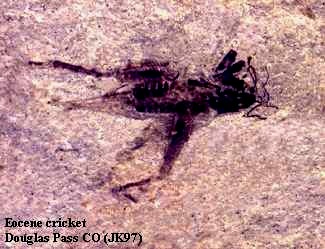 The
fossil record of insects reaches back into the Carboniferous. There
are some thirty-six orders of insects known at present, 99.9% of which
are winged, testifying to the tremendous adaptive advantage that flight
gives insects. Associated with the rise of flowering plants, insects
have shown increasing adaptations to feeding on flowers and related structures.
Today some 20% of insects depend on flowers, nectar or pollen for their
food source. This interdependence is even more evident if one considers
that some 65% of flowering plants are insect pollinated. The effect
of insects has been pervasive. To mention but one, as disease carriers,
they may even have been responsible for the decimation and extinction of
some mammalian groups.
The
fossil record of insects reaches back into the Carboniferous. There
are some thirty-six orders of insects known at present, 99.9% of which
are winged, testifying to the tremendous adaptive advantage that flight
gives insects. Associated with the rise of flowering plants, insects
have shown increasing adaptations to feeding on flowers and related structures.
Today some 20% of insects depend on flowers, nectar or pollen for their
food source. This interdependence is even more evident if one considers
that some 65% of flowering plants are insect pollinated. The effect
of insects has been pervasive. To mention but one, as disease carriers,
they may even have been responsible for the decimation and extinction of
some mammalian groups.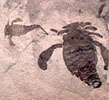 Although
not important as fossils, the merostomes are worth mentioning because they
include two interesting groups. Limulus, the horseshoe
crab, is often mentioned as a living fossil. This class also includes
the eurypterids, spectacular scorpion-like predators of the Paleozoic waters
which reached lengths up to 6 feet.
Although
not important as fossils, the merostomes are worth mentioning because they
include two interesting groups. Limulus, the horseshoe
crab, is often mentioned as a living fossil. This class also includes
the eurypterids, spectacular scorpion-like predators of the Paleozoic waters
which reached lengths up to 6 feet.